I thought it would be a great idea to alternate book quotes and book themes after my reviews! It’s a great way to understand what messages the author is trying to convey to the readers, and it gives readers a way to critically analyze and/ or critique the text!
WARNING: Reading book themes could spoil details for those who have not read Sisters of the Snake (yet). If you wish to avoid spoilers in the book, please avoid reading this post. Otherwise, proceed with your own caution and advisory.
CORRECTION: The neighboring country in the Ria and Rani world is spelled Kaama – not Kakmaan. This was an error on my part, and I apologize for the confusion.
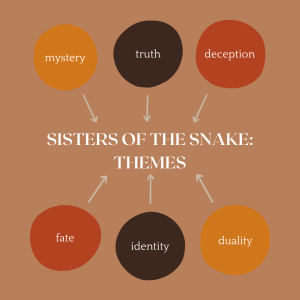
I will focus on six themes I found in Sisters of the Snake and provide an example for each of them.
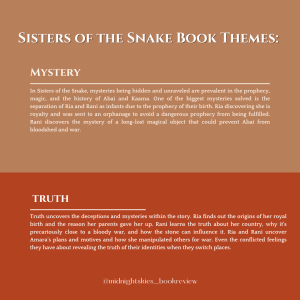
Mystery
In Sisters of the Snake, mysteries being hidden and unraveled are prevalent in the prophecy, magic, and the history of Abai and Kaama. One of the biggest mysteries solved is the separation of Ria and Rani as infants due to the prophecy of their birth. Ria discovering she is royalty and was sent to an orphanage to avoid a dangerous prophecy from being fulfilled. Rani discovers the mystery of a long-lost magical object that could prevent Abai from bloodshed and war.
Truth
Truth uncovers the deceptions and mysteries within the story. Ria finds out the origins of her royal birth and the reason her parents gave her up. Rani learns the truth about her country, why it’s precariously close to a bloody war, and how the stone can influence it. Ria and Rani uncover Amara’s plans and motives and how she manipulated others for war. Even the conflicted feelings they have about revealing the truth of their identities when they switch places.
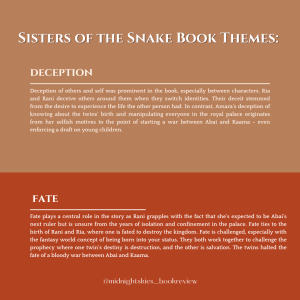
Deception
Deception of others and self was prominent in the book, especially between characters. Ria and Rani deceive others around them when they switch identities. Their deceit stemmed from the desire to experience the life the other person had. In contrast, Amara’s deception of knowing about the twins’ birth and manipulating everyone in the royal palace originates from her selfish motives to the point of starting a war between Abai and Kaama – even enforcing a draft on young children.
Fate
Fate plays a central role in the story as Rani grapples with the fact that she’s expected to be Abai’s next ruler but is unsure from the years of isolation and confinement in the palace. Fate ties to the birth of Rani and Ria, where one is fated to destroy the kingdom. Fate is challenged, especially with the fantasy world concept of being born into your status. They both work together to challenge the prophecy where one twin’s destiny is destruction, and the other is salvation. The twins halted the fate of a bloody war between Abai and Kaama.
Identity
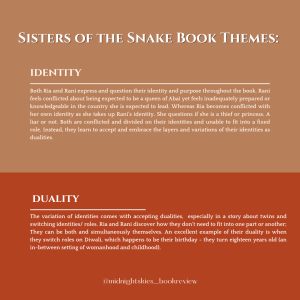
Both Ria and Rani express and question their identity and purpose throughout the book. Rani feels conflicted about being expected to be a queen of Abai yet feels inadequately prepared or knowledgeable in the country she is expected to lead. Whereas Ria becomes conflicted with her own identity as she takes up Rani’s identity. She questions if she is a thief or princess. A liar or not. Both are conflicted and divided on their identities and unable to fit into a fixed role. Instead, they learn to accept and embrace the layers and variations of their identities as dualities.
Duality
The variation of identities comes with accepting dualities, especially in a story about twins and switching identities/ roles. Ria and Rani discover how they don’t need to fit into one part or another; They can be both and simultaneously themselves. An excellent example of their duality is when they switch roles on Diwali, which happens to be their birthday – they turn eighteen years old (an in-between setting of womanhood and childhood).
Thank you for your patience and support! I’ll share more book themes with future books I read and do my best to provide minimal to moderate spoilers and analysis.
Questions for you
- What themes do you think will show up in the following book of Ria and Rani?
- What new themes or conflicts might arise?
- What are some themes you found?
- Did you like the overall message/ themes of the book? Why/ Why not?
 Midnight Skies