There were a lot of beautiful quotes in Aristotle and Dante Discover the Secrets of the Universe, but I found the themes to be very abundant and layered! The themes I found intersected with other themes and so I tried my best to have my analysis brief with text examples.
DISCLAIMER: I noticed these themes as I read the book, and there may be more themes in the book that I did not highlight. I will focus on six themes in the book that were prominent or noticed more when I read the book.
WARNING: Reading book themes could spoil details for those who have not read Aristotle and Dante Discover the Secrets of the Universe (yet). If you wish to avoid spoilers in the book, please avoid reading this post. Otherwise, proceed with caution.

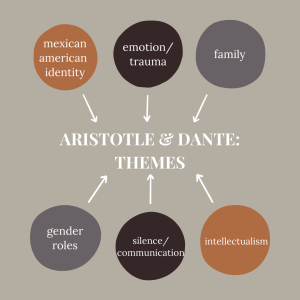
Here are the six themes I found in Aristotle and Dante Discover the Secrets of the Universe:

Mexican American Identity
The book illustrates the complications & divided perspectives of Latino Identity, specifically Mexican American identity. Ari & Dante are Mexican American teenage boys in El Paso, Texas, who often question each other & themselves on whether they are “good” or “bad” Mexicans. They ask the validity of their identity based on social constructs that generalize marginalized minorities, such as skin color, traditional cuisine, language, etc. However, both boys soon understand that their identity is not measured by how they fit into a box but how layered & fluid their identity is.
Emotion/ Trauma
Dante & Ari express their emotion oppositely: Ari restrains himself from expressing weakness, whereas Dante embraces his sensitivity & vulnerability. At the same time, trauma is illustrated differently between the boys & their fathers. Ari’s father is a Vietnam War veteran & a man of few words and is thus emotionally distant to suppress the trauma he experienced. In contrast, Dante’s father is an English professor & openly communicates & displays open affection with his son (something Ari is slightly envious of). It illustrates the gender roles in the Latino community, variation of family units, & the difficulty with emotional expression in Latino men.
Family
Ari’s family & Dante’s family are different yet share some similarities. The theme of family is central as both boys navigate their friendship. As the youngest child, Ari was overlooked & pressured to grow up to not be like his older brother, who is in prison. Whereas Dante’s family consists of his parents & himself & thus didn’t experience the sibling rivalry/competition that Ari did. Later, Dante’s mother is pregnant, & he expresses his hopes the baby will be the son that he couldn’t be for his parents. However, both families display their adoration, love, & acceptance of their sons.
Gender Roles
Traditional gender roles are illustrated & inverted, especially in male-identifying characters. Ari gets into fights & (like his father) deters from openly expressing his emotions. Yet, Dante & his father show each other affection & are unashamed of crying in front of others. An example is when Ari meets Dante’s parents & he sees Dante kiss his father on the cheek, & his father reciprocates; Ari is bewildered at the open display of affection that he & his father do not express with each other. Thus, traditional gender roles in Latino households, particularly within male-identifying relationships, are illustrated & complicated in Ari’s & Dante’s relationships with their fathers.
Silence/ Communication
Ari yearns for his father to communicate with him, despite both of them having difficulty in expressing their thoughts & emotions. Dante & his father frequently share and express themselves where they even have heated discussions or arguments about various topics. Even with the boys communicating with each other, they remain silent on serious issues – Dante can’t tell his parents about his desire to kiss boys & Ari can’t communicate with his parents about his imprisoned brother. The theme of silence is tied with shame as Ari’s parents feel shameful at the crime committed by Ari’s brother & feel that they failed as parents, and Dante is ashamed of the feelings he has with boys & expresses failure in being a good son.
Intellectualism
Intellectualism, as a theme, is illustrated in Dante and Ari’s interest in art, poetry, and literature. They are intellectuals and (just like their respective namesakes) philosophers questioning the world around them. Their friendship develops when Dante shares books with Ari. The exchange of books, thoughts, & ideas makes Ari desire to uncover the universe’s secrets (thus referencing the book’s title). Ari’s friendship with Dante also develops his interest in writing. Dante is skilled & interested in drawing and art, which fueled Ari’s interest in writing & overall curiosity (with the universe, his parents, his brother, himself, & Dante).
Thank you for your patience and support! I’ll continue to share more book themes and book quotes!
Questions for you
- What themes do you think show up in Aristotle and Dante Discover the Secrets of the Universe?
- What new themes or conflicts will the sequel touch upon?
- Did you like the overall message/themes of the book? Why or why not?
 Midnight Skies