A Pho Love Story Book Review

A Pho Love Story by Loan Le was a great read, and I could not put it down – I read it in less than 24 hours!!

I connected with both Bao and Linh and their desire to have their parents understand their aspirations. The themes of acceptance, immigration, and family were prominent and beautifully crafted!

Before we get into the book review and overview, I want to give out a few trigger warnings within the book. Despite fiction books being a form of escapism from the realities of our world, sometimes those realities can be reflected in fiction.
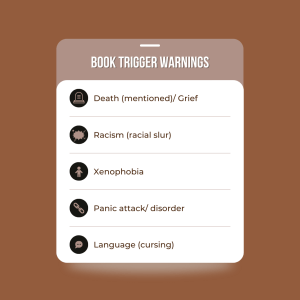
Trigger Warnings

  • Death (mentioned)/ Grief
  • Racism (racial slur)
  • Xenophobia
  • Panic attack/ disorder
  • Language (cursing)

Disclaimer

  • Book reviews are based on my personal opinion, my thoughts while reading the book, and how the book fulfills my book rating system and its categories.
  • Reviews are not meant to be hurtful – we all have different opinions on what is like in books such as preferences in a story’s point of view (POV), writing style, story pacing, etc.

I will do my best to create spoiler-free book reviews for my reviews; I don’t want to spoil it for people who haven’t yet read the book or plan to read it in the future.

Now, here is a breakdown of the six categories:

  • PLOT: The story centers on Bao and Linh and their growth throughout the story. Bao and Lin have parents who own rivaling pho restaurants across from each other, and both were expected to keep their distance. Bao is searching for direction in his future, whereas Linh already knows she wants to be an artist. An unexpected turn of events makes them cross each other’s paths and form a secret friendship without their families’ knowing. As their feelings grow and the desire to unravel the mystery of their families’ feud with each other, Bao and Linh come to understand their families, themselves, and their community to mend old wounds and form new futures.
  • SETTING: The story’s primary setting is Little Saigon in Southern California. Other settings mentioned include San Francisco, Vietnam, and Huntington Beach.
  • WRITING STYLE: Le’s writing style was one that I thoroughly enjoyed! The Chapters were written in dual Character POVs (point of view): Bao and Linh. The dialogue was enjoyable and realistic while mentioning mainstream pop culture and references without making it cringey. The medium pacing of the story builds up the plot and conflict in the story and the primary character’s growth. Some scenes and dialogues made me cry and outright laugh out loud!
  • CONFLICT/ RESOLUTION: Since the story focuses on Bao and Linh, the book centers on their respective internal/external conflicts within their chapter POV. They both discover new things about themselves, their motivations, and their families and understand them all in the story’s progression. One critique I have is how the family feud that began with their families stemmed from miscommunication.
  • CHARACTERS: The primary characters are Linh (an aspiring and passionate artist) and Bao (wandering/ unsure about his future, and his passions). Supporting characters include Bao’s parents, Linh’s parents, Viet (Bao’s friend), Allison (Linh’s friend), and Evelyn (Linh’s sister). In the book, the supporting and minor characters clash or question the actions of the two teenagers. Likewise, there is a layer of wants with most immigrant stories that don’t synchronize between different generations. Still, it helps move the story and illustrate the main characters’ motivations and personalities.
  • CHARACTER DEVELOPMENT: As a reader, I could already see some character development and growth (particularly in Part II of the book). There was a lot of internal/external conflict between Bao and Linh detailed in their respective chapters and perspectives. The book beautifully depicted Bao’s and Linh’s internal/external conflicts regarding their future aspirations, families, community, and love. Le illustrates young love’s beautiful growth, community support, and familial connections and understanding.
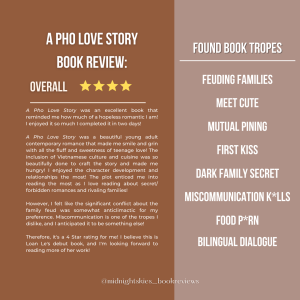
Overall Book Rating & Review

I could not put A Pho Love Story and stayed up until four in the morning to finish this book!

A Pho Love Story was an excellent book that reminded me how much of a hopeless romantic I am! I enjoyed it so much that I completed it in two days!

A Pho Love Story was a beautiful young adult contemporary romance that made me smile and grin with all the fluff and sweetness of teenage love! The inclusion of Vietnamese culture and cuisine was so beautifully done to craft the story and made me hungry! I enjoyed the character development and relationships the most! The plot enticed me into reading the most as I love reading about secret/ forbidden romances and rivaling families!

However, I felt like the significant conflict about the family feud was somewhat anticlimactic for my preference. Miscommunication is one of the tropes I dislike, and I anticipated it to be something else!

Therefore, it’s a 4 Star rating for me! I believe this is Loan Le’s debut book, and I’m looking forward to reading more of her work!

Found Book Tropes

  • Feuding Families
  • Meet Cute
  • Mutual Pining
  • First Kiss
  • Dark Family Secret
  • Miscommunication K*lls
  • Food P*rn
  • Bilingual Dialogue

Questions for You

  • What are your thoughts on A Pho Love Story?
  • What parts were retable to you?
  • What themes or ideas did you find?
A Pho Love Story Book Moodboard

Here is the book moodboard for A Pho Love Story by Loan Le! A contemporary romance that makes you smiling from the sweet moments and famished from all the food!

This was one of the first books I bought with the intention of making a book blog! I really liked the cover and thought the rivaling families trope with food would be a fun and enjoyable read! Book Review and Book Quotes to come!


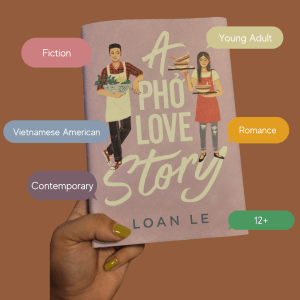
A Pho Love Story is…

  • Fiction
  • Young Adult
  • Contemporary
  • Romance
  • Vietnamese American rep
  • 12+
Image: Personal photo of A Pho Love Story book cover with a mustard yellow nail polish thumb in warm brown background. Colorful dialogue bubbles on cover say, “Young Adult, Contemporary, Vietnamese Rep, Fiction, Romance” & “12+”

A Pho Love Story Summary

A Pho Love Story by Loan Le Summary


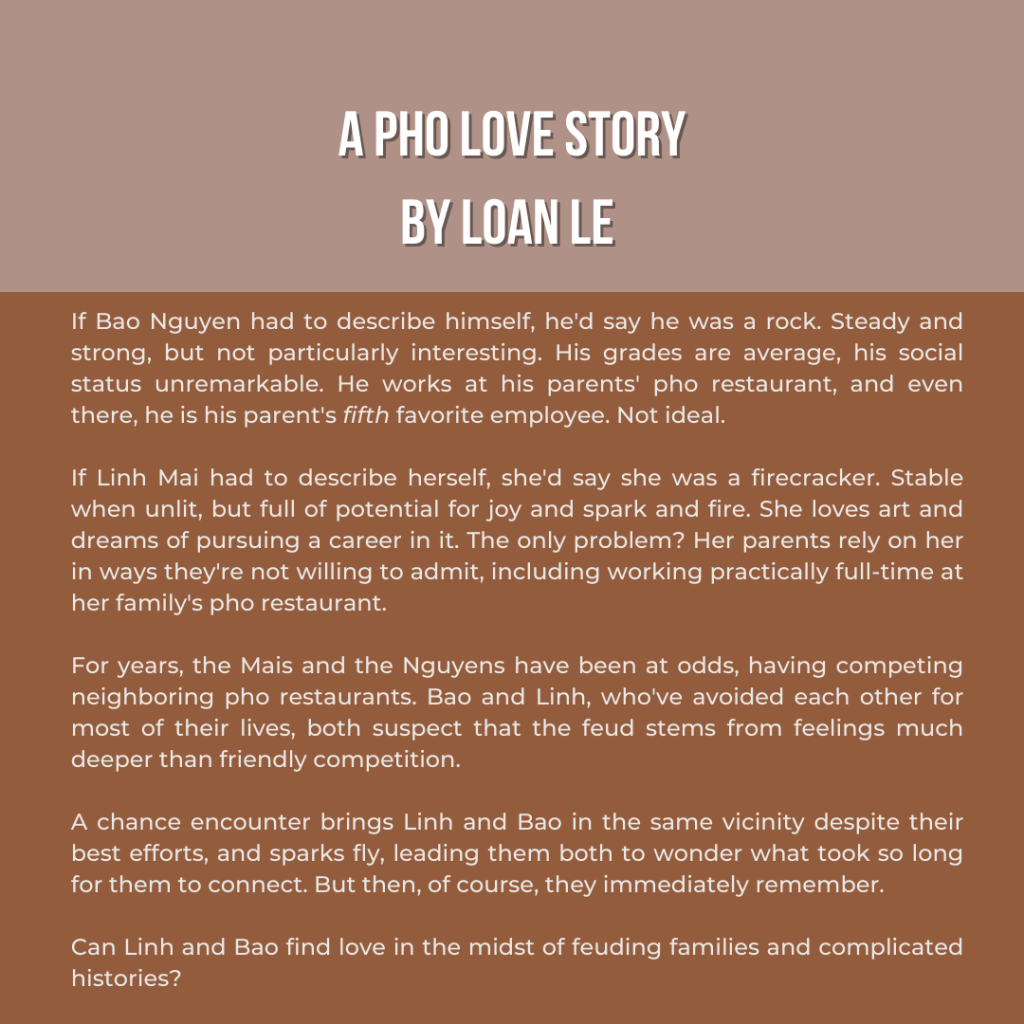
If Bao Nguyen had to describe himself, he’d say he was a rock. Steady and strong, but not particularly interesting. His grades are average, his social status unremarkable. He works at his parents’ pho restaurant, and even there, he is his parent’s fifth favorite employee. Not ideal.

If Linh Mai had to describe herself, she’d say she was a firecracker. Stable when unlit, but full of potential for joy and spark and fire. She loves art and dreams of pursuing a career in it. The only problem? Her parents rely on her in ways they’re not willing to admit, including working practically full-time at her family’s pho restaurant.

For years, the Mais and the Nguyens have been at odds, having competing neighboring pho restaurants. Bao and Linh, who’ve avoided each other for most of their lives, both suspect that the feud stems from feelings much deeper than friendly competition.

A chance encounter brings Linh and Bao in the same vicinity despite their best efforts, and sparks fly, leading them both to wonder what took so long for them to connect. But then, of course, they immediately remember.

Can Linh and Bao find love in the midst of feuding families and complicated histories?”


A Pho Love Story Moodboard

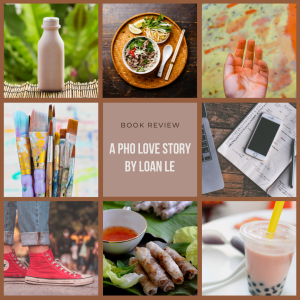
A Pho Love Story Moodboard: Top row – a picture of Bahn Xeo, a pink boba drink with a yellow straw, a hand stained in orange paint with a painted canvas as a backdrop. Middle row – stained paintbrushes against a white painted canvas backdrop, a bowl of Pho Bo with beef on top of a bamboo tray, a laptop, phone, and notebook with notes on a wooden table. Bottom row – a closeup of red converse high tops, a chocolate milk in a plastic bottle with a garden background, a close-up of Vietnamese egg rolls.

Aristotle & Dante Discover the Secrets of the Universe: Book Themes

There were a lot of beautiful quotes in Aristotle and Dante Discover the Secrets of the Universe, but I found the themes to be very abundant and layered! The themes I found intersected with other themes and so I tried my best to have my analysis brief with text examples.

DISCLAIMER: I noticed these themes as I read the book, and there may be more themes in the book that I did not highlight. I will focus on six themes in the book that were prominent or noticed more when I read the book.

WARNING: Reading book themes could spoil details for those who have not read Aristotle and Dante Discover the Secrets of the Universe (yet). If you wish to avoid spoilers in the book, please avoid reading this post. Otherwise, proceed with caution.

SPOILER ALERT AHEAD: Reading book themes could spoil details for those who have not read the book (yet). So you can either avoid this post or proceed with caution.

Here are the six themes I found in Aristotle and Dante Discover the Secrets of the Universe:

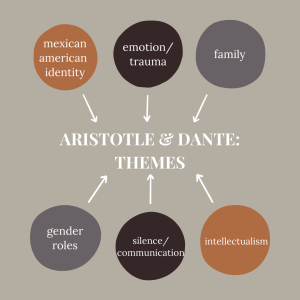
Aristotle & Dante Discover the Secrets of the Universe Themes (bubbles in brown, black, and gray): Mexican American identity, Emotion/Trauma, Family, Gender Roles, Silence/Communication, and Intellectualism.
Aristotle & Dante Book Themes: Mexican American Identity & Emotion/ Trauma.

Mexican American Identity

The book illustrates the complications & divided perspectives of Latino Identity, specifically Mexican American identity. Ari & Dante are Mexican American teenage boys in El Paso, Texas, who often question each other & themselves on whether they are “good” or “bad” Mexicans. They ask the validity of their identity based on social constructs that generalize marginalized minorities, such as skin color, traditional cuisine, language, etc. However, both boys soon understand that their identity is not measured by how they fit into a box but how layered & fluid their identity is.

Emotion/ Trauma

Dante & Ari express their emotion oppositely: Ari restrains himself from expressing weakness, whereas Dante embraces his sensitivity & vulnerability. At the same time, trauma is illustrated differently between the boys & their fathers. Ari’s father is a Vietnam War veteran & a man of few words and is thus emotionally distant to suppress the trauma he experienced. In contrast, Dante’s father is an English professor & openly communicates & displays open affection with his son (something Ari is slightly envious of). It illustrates the gender roles in the Latino community, variation of family units, & the difficulty with emotional expression in Latino men.

Aristotle & Dante Book Themes: Family & Gender Roles.

Family

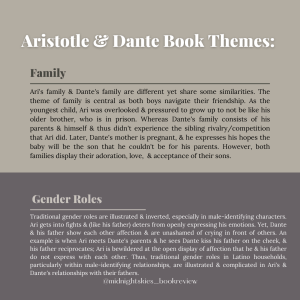
Ari’s family & Dante’s family are different yet share some similarities. The theme of family is central as both boys navigate their friendship. As the youngest child, Ari was overlooked & pressured to grow up to not be like his older brother, who is in prison. Whereas Dante’s family consists of his parents & himself & thus didn’t experience the sibling rivalry/competition that Ari did. Later, Dante’s mother is pregnant, & he expresses his hopes the baby will be the son that he couldn’t be for his parents. However, both families display their adoration, love, & acceptance of their sons.

Gender Roles

Traditional gender roles are illustrated & inverted, especially in male-identifying characters. Ari gets into fights & (like his father) deters from openly expressing his emotions. Yet, Dante & his father show each other affection & are unashamed of crying in front of others. An example is when Ari meets Dante’s parents & he sees Dante kiss his father on the cheek, & his father reciprocates; Ari is bewildered at the open display of affection that he & his father do not express with each other. Thus, traditional gender roles in Latino households, particularly within male-identifying relationships, are illustrated & complicated in Ari’s & Dante’s relationships with their fathers.

Aristotle & Dante Book Themes: Silence/ Communication & Intellectualism.

Silence/ Communication

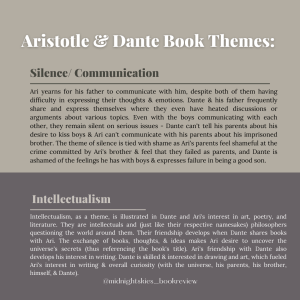
Ari yearns for his father to communicate with him, despite both of them having difficulty in expressing their thoughts & emotions. Dante & his father frequently share and express themselves where they even have heated discussions or arguments about various topics. Even with the boys communicating with each other, they remain silent on serious issues – Dante can’t tell his parents about his desire to kiss boys & Ari can’t communicate with his parents about his imprisoned brother. The theme of silence is tied with shame as Ari’s parents feel shameful at the crime committed by Ari’s brother & feel that they failed as parents, and Dante is ashamed of the feelings he has with boys & expresses failure in being a good son.

Intellectualism

Intellectualism, as a theme, is illustrated in Dante and Ari’s interest in art, poetry, and literature. They are intellectuals and (just like their respective namesakes) philosophers questioning the world around them. Their friendship develops when Dante shares books with Ari. The exchange of books, thoughts, & ideas makes Ari desire to uncover the universe’s secrets (thus referencing the book’s title). Ari’s friendship with Dante also develops his interest in writing. Dante is skilled & interested in drawing and art, which fueled Ari’s interest in writing & overall curiosity (with the universe, his parents, his brother, himself, & Dante).


Thank you for your patience and support! I’ll continue to share more book themes and book quotes!

Questions for you

  • What themes do you think show up in Aristotle and Dante Discover the Secrets of the Universe?
  • What new themes or conflicts will the sequel touch upon?
  • Did you like the overall message/themes of the book? Why or why not?

Aristotle & Dante Discover the Secrets of the Universe Book Review

Aristotle & Dante Discover the Secrets of the Universe by Benjamin Alire Sáenz was a wonderful read! Set in the 80’s with the friendship of two teenage boys growing up and learning about themselves, each other, and their families.

I connected to some of the themes and cultural aspects of the book as I grew up in a Mexican-American household and can see how these behaviors and ideas are still consistent and present in the Latine community.

Before we get into the book review and overview, I want to give out a few trigger warnings within the book. Despite fiction books being a form of escapism from the realities of our world, sometimes those realities can be reflected in fiction.

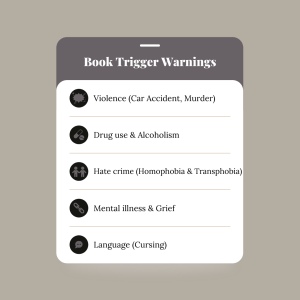
Trigger Warnings

  • Violence (Car Accident, Murder)
  • Drug use & Alcoholism
  • Hate crime (Homophobia & Transphobia)
  • Mental Illness & Grief
  • Language (Cursing)

Disclaimer

  • Book reviews are based on my personal opinion, my thoughts while reading the book, and how the books fulfills my book rating system and its categories.
  • Reviews are not meant to be hurtful – we all have different opinions on what we like in books such as preferences in story point of view (POV), writing style, story pacing, etc.

For my reviews, I will so my best to create spoiler-free book reviews to those who have not yet read the book or those who plan to read the book in the future.

Now, here is a breakdown of the six categories:

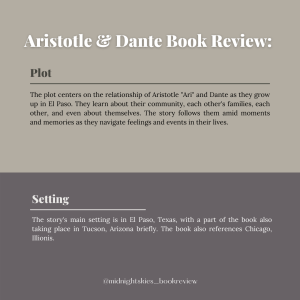
  • PLOT: The plot centers on the relationship of Aristotle “Ari” and Dante as they grow up in El Paso. They learn about their community, each other’s families, each other, and even about themselves. The story follows them amid moments and memories as they navigate feelings and events in their lives.
  • SETTING: The story’s primary setting is in El Paso, Texas, with a part of the book also taking place in Tucson, Arizona, briefly. The book also references Chicago, Illinois.
  • WRITING STYLE: Sáenz’s writing style was straightforward and poignant to provide insight into Aristotle’s thoughts and feelings to create fast-paced storytelling! From Aristotle’s perspective, the book provided insight to a dynamic character who didn’t know how to express his emotions. Since I grew up in a Mexican-American household, I related a lot to the experiences of Ari and Dante. Some dialogues and scenes made me laugh out loud and silently weep! One critique I have is that there was so much ‘said’ in the book for my liking.
  • CONFLICT/ RESOLUTION: As a coming-of-age story, there were many conflicts throughout the book resolved relatively well. The realism to their issues and their solutions didn’t feel like there were any loose ends untied.
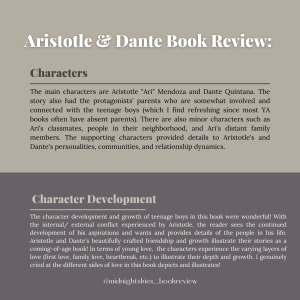
  • CHARACTERS: The main characters are Aristotle “Ari” Mendoza and Dante Quintana. The story also had the protagonists’ parents who are somewhat involved and connected with the teenage boys (which I find refreshing since most YA books often have absent parents). There are also minor characters such as Ari’s classmates, people in their neighborhood, and Ari’s distant family members. The supporting characters provided details to Aristotle’s and Dante’s personalities, communities, and relationship dynamics.
  • CHARACTER DEVELOPMENT: The character development and growth of teenage boys in this book were wonderful! With the internal/ external conflict experienced by Aristotle, the reader sees the continued development of his aspirations and wants and provides details of the people in his life. Aristotle and Dante’s beautifully crafted friendship and growth illustrate their stories as a coming-of-age book! In terms of young love, the characters experience the varying layers of love (first love, family love, heartbreak, etc.) to illustrate their depth and growth. I genuinely cried at the different sides of love in this book depicts and illustrates!

Overall Book Rating & Review

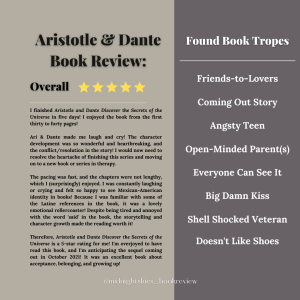
I finished Aristotle and Dante Discover the Secrets of the Universe in five days! I enjoyed the book from the first thirty to forty pages!

Ari & Dante made me laugh and cry! The character development was so wonderful and heartbreaking, and the conflict/resolution in the story! I would now need to resolve the heartache of finishing this series and moving on to a new book or series in therapy.

The pacing was fast, and the chapters were not lengthy, which I (surprisingly) enjoyed. I was constantly laughing or crying and felt so happy to see Mexican-American identity in books! Because I was familiar with some of the Latine references in the book, it was a lovely emotional rollercoaster! Despite being tired and annoyed with the word ‘said’ in the book, the storytelling and character growth made the reading worth it!

Therefore, Aristotle and Dante Discover the Secrets of the Universe is a 5-star rating for me! I’m overjoyed to have read this book, and I’m anticipating the sequel coming out in October 2021! It was an excellent book about acceptance, belonging, and growing up!

Found Book Tropes

  • Friends-to-Lovers
  • Coming Out Story
  • Angsty Teen
  • Open-Minded Parent(s)
  • Everyone Can See It
  • Big Damn Kiss
  • Shell Shocked Veteran
  • Doesn’t Like Shoes

NOTE: A sequel title Aristotle and Dante Dive Into the Waters of the World is set to be released in October. I have pre-ordered it and look forward to reading and reviewing it in the near future!

Questions for You

  • What are your thoughts on Aristotle and Dante Discover the Secrets of the Universe?
  • What parts of the book were relatable to you?
  • What are some things you look forward in the upcoming sequel?

Aristotle and Dante Discover the Secrets of the Universe Book Moodboard

I apologize for the delay in book review updates! July had been a very hectic month for me as I had to sort out a lot of things for school and work. Fortunately, it should be resolved soon and I can continue making more frequent updates!

I’ve seen this book for some time on different social media platforms and was very curious to read it! As much as I love reading fantasy books, I was really happy and excited to get my hands on this contemporary book!


Aristotle & Dante Discover the Secrets of the Universe is…

  • Coming-of-Age
  • Young Adult
  • Contemporary
  • Fiction
  • LGBTQ+ rep
  • 12+
Image: Aristotle & Dante Discover the Secrets of the Universe with colorful bubbles with different genres included.

Aristotle & Dante Discover the Secrets of the Universe Summary

Aristotle & Dante Discover the Secrets of the Universe by Benjamin Alire Sáenz Summary

Aristotle is an angry teen with a brother in prison. Dante is a know-it-all who has an unusual way of looking at the world. When the two meet at the swimming pool, they seem to have nothing in common. But as the loners start spending time together, they discover that they share a special friendship – the kind that changes lives and lasts a lifetime. And it is through this friendship that Ari and Dante will learn the most important truths about themselves and the kind of people they want to be.


Aristotle & Dante Discover the Secrets of the Universe Moodboard

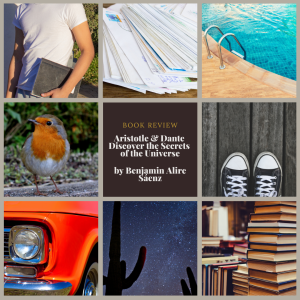
Aristotle & Dante Discover the secrets of the Universe Moodboard: Top row – stacks of books, teenage boy carrying a book, a swimming pool with railing. Middle row – mailed letters splayed out, converse shoes against wooden floorboards, a robin bird on the road. Bottom row – a cactus against a starry dark landscape, headlight of a red truck, two hands holding each other with rainbow bracelets.

Sisters of the Snake: Book Themes

I thought it would be a great idea to alternate book quotes and book themes after my reviews! It’s a great way to understand what messages the author is trying to convey to the readers, and it gives readers a way to critically analyze and/ or critique the text!

WARNING: Reading book themes could spoil details for those who have not read Sisters of the Snake (yet). If you wish to avoid spoilers in the book, please avoid reading this post. Otherwise, proceed with your own caution and advisory.

SPOILER ALERT AHEAD: Reading book themes could spoil details for those who have not read the book (yet). So you can avoid this post or proceed with caution.

CORRECTION: The neighboring country in the Ria and Rani world is spelled Kaama – not Kakmaan. This was an error on my part, and I apologize for the confusion.

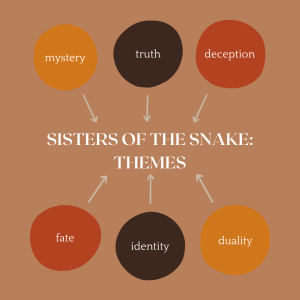
Sisters of the Snake Themes: Mystery, Truth, Deception, Fate, Identity, and Duality.

I will focus on six themes I found in Sisters of the Snake and provide an example for each of them.

Sisters of the Snake Book Themes: Mystery and Truth

Mystery

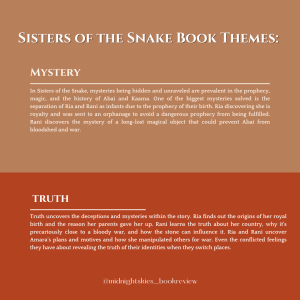
In Sisters of the Snake, mysteries being hidden and unraveled are prevalent in the prophecy, magic, and the history of Abai and Kaama. One of the biggest mysteries solved is the separation of Ria and Rani as infants due to the prophecy of their birth. Ria discovering she is royalty and was sent to an orphanage to avoid a dangerous prophecy from being fulfilled. Rani discovers the mystery of a long-lost magical object that could prevent Abai from bloodshed and war.

Truth

Truth uncovers the deceptions and mysteries within the story. Ria finds out the origins of her royal birth and the reason her parents gave her up. Rani learns the truth about her country, why it’s precariously close to a bloody war, and how the stone can influence it. Ria and Rani uncover Amara’s plans and motives and how she manipulated others for war. Even the conflicted feelings they have about revealing the truth of their identities when they switch places.

Sisters of the Snake Book Themes: Deception and Fate

Deception

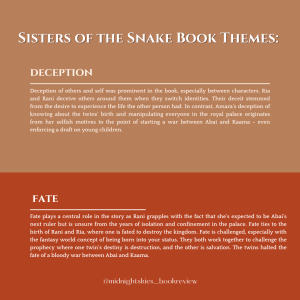
Deception of others and self was prominent in the book, especially between characters. Ria and Rani deceive others around them when they switch identities. Their deceit stemmed from the desire to experience the life the other person had. In contrast, Amara’s deception of knowing about the twins’ birth and manipulating everyone in the royal palace originates from her selfish motives to the point of starting a war between Abai and Kaama – even enforcing a draft on young children.

Fate

Fate plays a central role in the story as Rani grapples with the fact that she’s expected to be Abai’s next ruler but is unsure from the years of isolation and confinement in the palace. Fate ties to the birth of Rani and Ria, where one is fated to destroy the kingdom. Fate is challenged, especially with the fantasy world concept of being born into your status. They both work together to challenge the prophecy where one twin’s destiny is destruction, and the other is salvation. The twins halted the fate of a bloody war between Abai and Kaama.

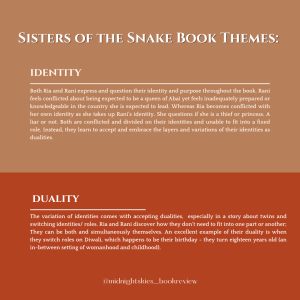
Identity

Both Ria and Rani express and question their identity and purpose throughout the book. Rani feels conflicted about being expected to be a queen of Abai yet feels inadequately prepared or knowledgeable in the country she is expected to lead. Whereas Ria becomes conflicted with her own identity as she takes up Rani’s identity. She questions if she is a thief or princess. A liar or not. Both are conflicted and divided on their identities and unable to fit into a fixed role. Instead, they learn to accept and embrace the layers and variations of their identities as dualities.

Duality

The variation of identities comes with accepting dualities, especially in a story about twins and switching identities/ roles. Ria and Rani discover how they don’t need to fit into one part or another; They can be both and simultaneously themselves. An excellent example of their duality is when they switch roles on Diwali, which happens to be their birthday – they turn eighteen years old (an in-between setting of womanhood and childhood).


Thank you for your patience and support! I’ll share more book themes with future books I read and do my best to provide minimal to moderate spoilers and analysis.

Questions for you

  • What themes do you think will show up in the following book of Ria and Rani?
  • What new themes or conflicts might arise?
  • What are some themes you found?
  • Did you like the overall message/ themes of the book? Why/ Why not?

Sisters of the Snake Book Review

Sisters of the Snake by Sarena and Sasha Nanua, a sister author duo, was a fantastical and beautiful read! I love that this is an Indian/Desi-inspired fantasy retelling of the Prince and the Pauper because there is something so amazing about diversifying your bookshelf and reading inclusive books!

I personally like diverse retellings of classic literature and folklore – it brings in different perspectives, voices, and nuances!

Book Review: Sisters of the Snake by Sarena and Sasha Nanua

Before we get to the book review and overview, I want to give out a few trigger warnings within the book. Despite fiction books being a form of escapism from the realities of our world, sometimes those realities can be reflected in fiction.

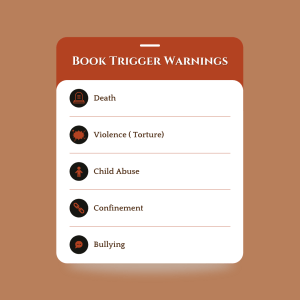
Trigger Warnings

  • Death
  • Violence (Torture)
  • Child Abuse
  • Confinement
  • Bullying

Disclaimer

  • Book reviews are based on my personal opinion, my thoughts while reading the book, and how the book fulfills my book rating system and its categories.
  • Reviews are not meant to be hurtful – we all have different opinions on what we like in books, such as preferences in story point of view (POV), writing style, story pacing, etc.

For my reviews, I will do my best to create spoiler-free book reviews to those who have not read the book or those who plan to read the book in the future.

Now here is a breakdown of the six categories:

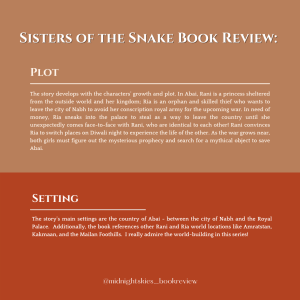
  • PLOT: The story develops with the characters’ growth and plot. In Abai, Rani is a princess sheltered from the outside world and her kingdom; Ria is an orphan and skilled thief who wants to leave the city of Nabh to avoid her conscription royal army for the upcoming war. In need of money, Ria sneaks into the palace to steal as a way to leave the country until she unexpectedly comes face-to-face with Rani, who are identical to each other! Rani convinces Ria to switch places on Diwali night to experience the life of the other. As the war grows near, both girls must figure out the mysterious prophecy and search for a mythical object to save Abai.
  • SETTING: The story’s main settings are the country of Abai – between the city of Nabh and the Royal Palace. Additionally, the book references other Rani and Ria world locations like Amratstan, Kakmaan, and the Mailan Foothills. I really admire the world-building in this series!
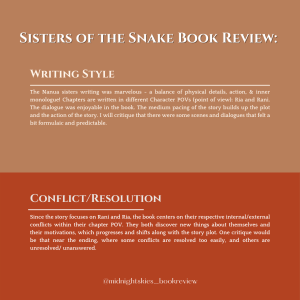
  • WRITING STYLE: The Nanua sisters writing was marvelous – a balance of physical details, action, & inner monologue! Chapters are written in different Character POVs (point of view): Ria and Rani. The dialogue was enjoyable in the book. The medium pacing of the story builds up the plot and the action of the story. I will critique that there were some scenes and dialogues that felt a bit formulaic and predictable.
  • CONFLICT/ RESOLUTION: Since the story focuses on Rani and Ria, the book centers on their respective internal/external conflicts within their chapter POV. They both discover new things about themselves and their motivations, which progresses and shifts along with the story plot. One critique would be that near the ending, where some conflicts are resolved too easily, and others are unresolved/ unanswered.
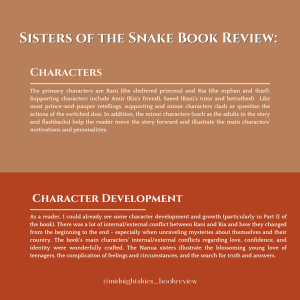
  • CHARACTERS: The primary characters are Rani (the sheltered princess) and Ria (the orphan and thief). Supporting characters include Amir (Ria’s friend), Saeed (Rani’s tutor and betrothed). Like most prince-and-pauper retellings, supporting and minor characters clash or question the actions of the switched duo. In addition, the minor characters (such as the adults in the story and flashbacks) help the reader move the story forward and illustrate the main characters’ motivations and personalities.
  • CHARACTER DEVELOPMENT: As a reader, I could already see some character development and growth (particularly in Part II of the book). There was a lot of internal/external conflict between Rani and Ria and how they changed from the beginning to the end – especially when unraveling mysteries about themselves and their country. The book’s main characters’ internal/external conflicts regarding love, confidence, and identity were wonderfully crafted. The Nanua sisters illustrate the blossoming young love of teenagers, the complication of feelings and circumstances, and the search for truth and answers.
Sisters of the Snake Review: Characters and Character Development.

Overall Book Rating & Review

Sisters of the Snake took me some time to complete reading, but I enjoyed it so much whenever I had the chance to delve into this book!

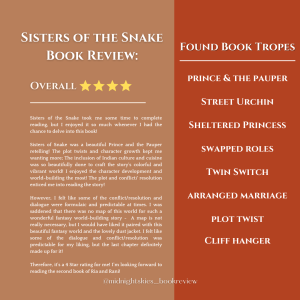
Sisters of Snake was a beautiful Prince and the Pauper retelling! The plot twists and character growth kept me wanting more; The inclusion of Indian culture and cuisine was so beautifully done to craft the story’s colorful and vibrant world! I enjoyed the character development and world-building the most! The plot and conflict/ resolution enticed me into reading the story!

However, I felt like some of the conflict/resolution and dialogue were formulaic and predictable at times. I was saddened that there was no map of this world for such a wonderful fantasy world-building story – A map is not really necessary, but I would have liked it paired with this beautiful fantasy world and the lovely dust jacket. I felt like some of the dialogue and conflict/resolution was predictable for my liking, but the last chapter definitely made up for it!

Therefore, it’s a 4 Star rating for me! I’m looking forward to reading the second book of Ria and Rani!

Found Book Tropes

  • Prince and the Pauper
  • Street Urchin
  • Sheltered Princess
  • Swapped Roles
  • Twin Switch
  • Arranged Marriage
  • Plot Twist
  • Cliff Hanger
Sisters of the Snake Review: Overall Rating & Book Tropes.

NOTE: A sequel to Sisters of the Snake is being worked on at the time of this blog post so a released date has not been announced at this time.

Questions for You

  • What are your thoughts on Sisters of the Snake?
  • Are there any book retellings you recommend?
  • What are some things you hope to be in the sequel?

Sisters of the Snake Book Moodboard

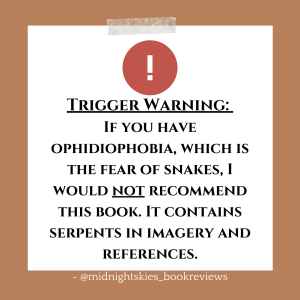
I would like to notify you all of a trigger warning for those who have Ophidophobia, which is the fear of snakes. If you have this phobia, I would NOT recommend this book because it contains serpents and snakes in imagery, references, and on the dust cover.

If snakes or serpents do not bother you, you may proceed through this post.

Trigger Warning: If you have Ophidiophobia, which is the fear of snakes, I would NOT recommend this book. It contains Serpents in imagery and references.

NOTE: Based on my personal experience and relationships, I noticed people with animal phobias have a more reactive response to their specific phobia, such as being unable to see illustrated images or leaving the room at the sight/ mention of said animal. From now on, I will be making trigger warnings on books with strong imagery and references to snakes and spiders.

Phobias are a type of anxiety disorder that causes fear ranging from mild to moderate to extreme. Oftentimes, these phobias can interfere with peoples’ day to day life and often block them from doing what is best for their mental and emotional health. Despite wanting to share books with others, I also want to considerate of other peoples’ mental health and boundaries.

If there are any other phobias you would like me to include, feel free to leave a comment or contact me about it.


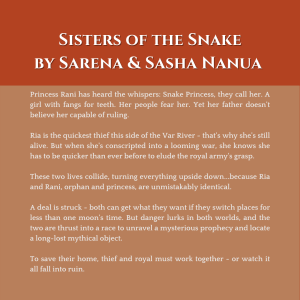
Sisters of the Snake by Sarena and Sasha Nanua Summary.

Sisters of the Snake Summary

Princess Rani has heard the whispers: Snake Princess, they call her. A girl with fangs for teeth. Her people fear her. Yet her father doesn’t believe her capable of ruling

Ria is the quickest thief this side of the Var River – that’s why she’s still alive. But when she’s conscripted into a looming war, she knows she has to be quicker than ever before to elude the royal army’s grasp.

These two lives collide, turning everything upside down…because Ria and Rani, orphan and princess, are unmistakably identical.

A deal is struck – both can get what they want if they switch places for less than one moon’s time. But danger lurks in both worlds, and the two are thrust into a race to unravel a mysterious prophecy and locate a long-lost mythical object.

To save their home, thief and royal must work together – or watch it all fall into ruin.


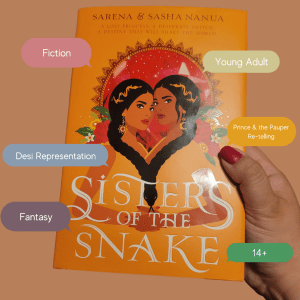
Sisters of the Snake is…

  • Fiction
  • Young Adult
  • Indian/Desi Representation
  • Prince and the Pauper Retelling
  • Fantasy
  • 14+
Image: Sisters of the Snake book cover held with colorful bubbles with different genres included.

Sisters of the Snake Moodboard

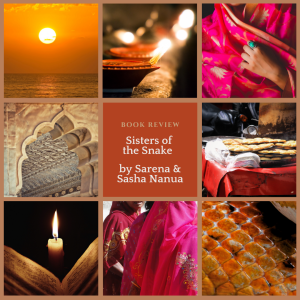
Sisters of the Snake Moodboard: Top row -orange sunset above ocean, diwali candles, woman with a ring on her finger and a magenta Indian clothing. Middle row – traditional Indian architecture, a lit fountain photographed at night, a stack of naan on top of a red table cloth. Bottom row – a single lit candle illuminating a book, two girls dressed in the same traditional Indian clothing in magenta, and a close up of orange and brown snake scales.

Crooked Kingdom: My Top 5 Favorite Quotes

I would like to share some of my favorite quotes from Crooked Kingdom. There are not a lot of humorous quotes or exchanges.

I initially intended to have a Top 10 Favorite Quotes, because there were many moments in Crooked Kingdom that were so memorable and beautiful in their own way. However, I felt that would be unfair for future books I intend to read and therefore, kept the list to five.

These favorite quotes are based on my personal opinion – this is not meant to demean or offend anyone if your favorite quote is not in here. Everyone has their own set of favorite quotes and all are valid – feel free to comment on your favorite quote or book scenes!

WARNING: Reading book quotes could spoil details for those who have not read Crooked Kingdom (yet). If you wish to avoid spoilers in the book, please avoid reading this post. Otherwise, proceed at your own caution and advisory.

Spoiler Alert! Ahead: Reading book quotes could spoil details for those who have not read the book (yet). So you can either avoid this post or proceed with caution.

#5

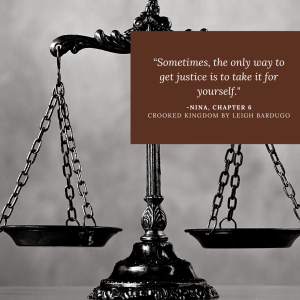
Sometimes, the only way to get justice is to take it for yourself.”

-Nina, Chapter 6
“Sometimes, the only way to get justice is to take it for yourself.” – Nina, Chapter 6

Despite this being Nina’s POV chapter, the quote is from Kaz’s dialogue to Jesper’s father. I really liked this quote because it sets one of the big themes in Six of Crows and Crooked Kingdom – the importance of justice. Despite the underhanded approach of trickery, lies, and disguises, the intention of the Crows is to get their own justice after their experience with injustice in the world (and circumstances). Often these injustices are enacted by untrustworthy adults in the Grishaverse (except for Jesper’s father), so I believe this quote strongly resonates with young readers and the teenage characters seeking justice within an unjust world that is not structured in their favor or side.

#4

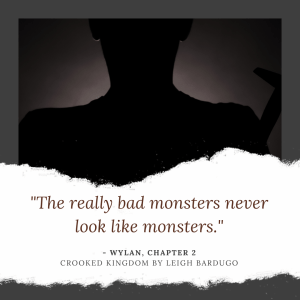
“The really bad monsters never look like monsters.”

– Wylan, Chapter 2
“The really bad monsters never look like monsters.”
– Wylan, Chapter 2

Another dialogue quote from Kaz from Wylan’s POV chapter. During this scene, Kaz and Wylan break into the home of Jan Van Eck’s lawyer, Cornelius Smeet, and are discovered by the Smeet’s young daughter. Kaz threatens her and warns her to go back to bed as both boys try to find a way to get Inej back from Van Eck. This exchange between Kaz and the little girl parallels another scene on the previous page where Kaz threatens Smeet’s clerk, which was considerably much darker and crueler to illustrate Kaz’s ruthless nature and resulting in the clerk’s demise. Before the clerk’s end, Kaz stated there were “no good men in Ketterdam,” which solidifies his perspective regarding monsters in the world. However, this scene also highlights the genuine cruelty and brutal nature are hidden in the real monsters of the world. This example can be shown in most adults in the series, who abuse their power over the powerless and use their status and wealth to get away with abuse.

#3

“No mourners, no funerals. Another way of saying good luck. But it was something more. A dark wink to the fact that there would be no expensive burials for people like them, no marble markers to remember their names, no wreaths of myrtle and rose.”

– Inej, Chapter 17
“No mourners, no funerals. Another way of saying good luck. But it was something more. A dark wink to the fact that there would be no expensive burials for people like them, no marble markers to remember their names, no wreaths of myrtle and rose.” – Inej, Chapter 17

I love how this quote explains the Dregs and Crows phrase! It emphasizes the classism and disparity of wealth within Ketterdam. Funerals and mourners are a sign of wealth, luxury, and memory; in contrast, the people living in the Barrel (who are arguably the poorest and living in the most harshest conditions) do not have the luxury or expense to pay for a funeral or mourn a life. It also foreshadows a character’s death and how the crews’ actions afterward is an inversion and negation of this phrase to illustrate how there will be people who will mourn their loved ones even if the world is unaware of who they are.

#2

“Thoughts of moonlight and silken hair evaporated in a black bolt of fury. Kaz saw Inej tug on the sleeve of her left forearm, where the Menagerie tattoo had once been. He had the barest inkling of what she’d endured there, but he knew what it was to feel helpless, and Van Eck had managed to make her feel that way again. Kaz was going to have to find a new language of suffering to teach that smug merch son of a bitch.”

– Kaz, Chapter 12
Thoughts of moonlight and silken hair evaporated in a black bolt of fury. Kaz saw Inej tug on the sleeve of her left forearm, where the Menagerie tattoo had once been. He had the barest inkling of what she’d endured there, but he knew what it was to feel helpless, and Van Eck had managed to make her feel that way again. Kaz was going to have to find a new language of suffering to teach that smug merch son of a bitch.” – Kaz, Chapter 12

Kaz’s POV chapters were my favorites in Crooked Kingdom, and the quote above is one of the reasons. During this chapter, Kaz and Inej are scouting the sugar silos owned by Jan Van Eck to sabotage them. In this chapter, Kaz worries about Inej’s safety after rescuing her from Van Eck (i.e., demanding a safety net be set in place and anxious when she seems to not return to the boat as soon as he expected). Despite the importance of this scouting mission, Kaz imagines touching Inej’s hair on a couple of occasions. However, when she reveals how Van Eck confined her to made her feel fear and doubt, Kaz reflects back on Inej’s trauma and her feelings of helplessness while simultaneously feeling angered that Van Eck made Inej recount those negative experiences. Obviously, he couldn’t offer her the words of comfort she wanted, but I believe the dialogue above (and near the end) presents as a close second and (in my opinion) a confession of love.

#1

Kaz thought he knew the language of pain intimately, but this ache was new. It hurt to stand here like this, so close to the circle of her arms. It isn’t easy for me either. After all she’d endured, he was the weak one. But she would never know what it was like for him to see Nina pull her close, watch Jesper loop his arm through hers, what it was to stand in doorways and against walls and know he could never draw nearer. But I’m here now, he thought wildly.

– Kaz, Chapter 26
“Kaz thought he knew the language of apin intimately, but this ache was new. It hurt to stand here like this, so close to the circle of her arms. It isn’t easy for me either. After all she’d endured, he was the weak one. But she would never know what it was like for him to see Nina pull her close, watch Jesper loop his arm through hers, what it was to stand in doorways and against walls and know he could never draw nearer. But I’m here now, he thought wildly.” – Kaz, Chapter 26

This is, hands down, my favorite quote from Kaz! In this chapter, where he is helping Inej bandage her wounds without his gloves – both of them are vulnerable, and he is fighting against his aversion to touch. In this quote, the reader gets a perspective of Kaz’s inner conflict of physical touch, his affection for Inej, and his desire for intimacy with her. This chapter focuses on Kaz, Inej, their trauma, and their yearning for each other. Kaz knows about pain in the way it physically, mentally, and emotionally harms – but he recounts that “this ache [love] was new.” In both books, Kaz had crushes before meeting Inej, but they were not equivalent to the love he feels for her. This quote and chapter solidifies and reflects the mutual love and trust Kaz and Inej have for each other and how they want to heal from their trauma to move forward together.


Those are my Top 5 Favorite Quotes from Crooked Kingdom by Leigh Bardugo! I tried really hard to narrow it to down and I hope you enjoyed my list!

Thank you so much for your patience and support!

Please comment below on your favorite quotes in Crooked Kingdom or answer any of the other questions down below!

Questions for You

  • What are your favorite book scenes from Crooked Kingdom? Why?
  • Did any of these quotes resonate with or connected with? Why or why not?
  • What were some of your thoughts on Crooked Kingdom?

Crooked Kingdom Book Review

Crooked Kingdom by Leigh Bardugo was a great conclusions – it was a bittersweet experience reading and completing the Six of Crows duology!

Book Review: Crooked Kingdom

Before we get to the book review and overview, I want to give out a few trigger warnings within the book. Despite fiction books being a form of escapism from the realities of our world, sometimes those realities can be reflected in fiction.

Trigger Warnings

  • Violence (torture, gun, knife)
  • Addiction (gambling, drugs)
  • Recounts of child abuse
  • Recounts of sex abuse
  • Langauge (mild to moderate)
Crooked Kingdom: Trigger Warnings

Disclaimer

  • Book reviews are based on my personal opinion, my thoughts while reading the book, and how the book fulfills my book rating system and it’s categories.
  • Reviews are not meant to be hurtful – we all have different opinions on what we like in books, such as preferences in story point of view (POV), writing style, story pacing, etc.

For my reviews, I will do my best to review the book without revealing spoilers to those who are currently reading, or have not read the book. Now, a look and mild breakdown of the six categories:

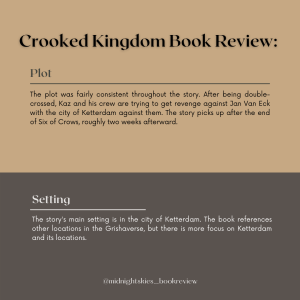
  • PLOT: The plot was fairly consistent throughout the story. After being double-crossed, Kaz and his crew are trying to get revenge against Jan Van Eck with the city of Ketterdam against them. The story picks up after the end of Six of Crows, roughly two weeks afterward.
  • SETTING: The story’s main setting is in the city of Ketterdam. The book references other locations in the Grishaverse, but there is more focus on Ketterdam and its locations.
Crooked Kingdom Review: Plot and Setting
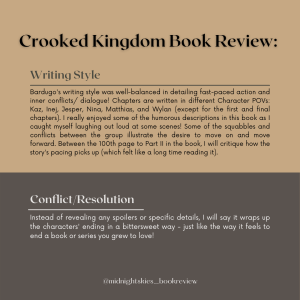
  • WRITING STYLE: Bardugo’s writing style was well-balanced in detailing fast-paced action and inner conflicts/ dialogue! Chapters are written in different Character POVs: Kaz, Inej, Jesper, Nina, Matthias, and Wylan (except for the first and final chapters). I really enjoyed some of the humorous descriptions in this book as I caught myself laughing out loud at some scenes! Some of the squabbles and conflicts between the group illustrate the desire to move on and move forward. Between the 100th page to Part II in the book, I will critique how the story’s pacing picks up (which felt like a long time reading it).
  • CONFLICT/ RESOLUTION: Instead of revealing any spoilers or specific details, I will say it wraps up the characters’ ending in a bittersweet way – just like the way it feels to end a book or series you grew to love!
Crooked Kingdom Review: Writing Style and Conflict/Resolution.
  • CHARACTERS: The main characters are the Kaz Brekker, Inej Ghafa, Jesper Fahey, Nina Zenik, Matthias Helvar, and Wylan Van Eck. This story contains more than one heist in this installment, and the complexity and layers of it show the dire and circumstances the Crows are in. Additionally, the minor characters in the story help reveal the main characters’ motivations and personalities while helping move forward the story’s plot and momentum.
  • CHARACTER DEVELOPMENT: The character development and growth in this book were well done! With the internal/ external conflict experienced by the Crows, the reader sees the continued development in the characters’ motivations and aspirations which are illustrated wonderfully at the end of the book. Again, the romance in the book was beautifully crafted to illustrate the desire, yearning, and pain of young love to reveal character depth and growth. I would be remiss if I didn’t say that I both squealed and cried on not just the romantic dynamics in the story but the overall layered relationships between the Crows.
Crooked Kingdom Review: Characters and Character Development

Overall Book Rating

Likewise, with Crooked Kingdom, it took me roughly a week to finish reading it as I continued to work and was only available to read it after work hours and before bed.

Crooked Kingdom is both my comfort book and the one that broke my heart! The character development was so wonderful and heartbreaking, and the conflict/resolution in the story! I would now need to resolve the heartache of finishing this series and moving on to a new book or series in therapy.

Just like in Six of Crows, the pacing at the beginning was slow. It picked up and then basically became an emotional rollercoaster! It isn’t until the second half that it picks up momentum, but I didn’t mind the slow build-up to the story’s pivotal and emotional moments.

Therefore, Crooked Kingdom is a 5-star rating for me! I’m heartbroken and delighted to complete the Six of Crows Duology. It’s a bittersweet moment as I overcame my reading slump, but I am so sad that this series came to an end. I’m looking forward to reading more of the Grishaverse series and other books on my To-Be-Read (TBR) list!

Found Book Tropes

  • Morally Gray Characters
  • Found Family
  • Official Couple(s)
  • No Holds Beatdown
  • Parallel Characters
  • Big Damn Kiss
  • Frame the Guilty Party
  • Bittersweet Ending
Crooked Kingdom Review: Overall Rating & Book Tropes

NOTE: I heard a rumor that (allegedly) there is a third Six of Crows installment in the works but there is no official release date. If this is true, I would like to express how excited I am at the potentiality of reading a timeskip story of the Crows after Crooked Kingdom, but I would most likely be emotionally unprepared!

Questions for You

  • What were your thoughts on Crooked Kingdom?
  • If a third book installment of Six of Crows is confirmed, what are some things you hope to see (or not see)?